Mind The Gap – do what you say?
We’ve recently been talking about the 5 Enablers of Employee Engagement blog: what they are, and how to use them to improve engagement.
One of the enablers is organizational integrity – the values on the wall are reflected in day-to-day behaviours. There is no ‘say-do’ gap.
Organisational integrity is about ensuring the words of an organisation match the behaviours. Whilst this sounds simple enough, many of us have experienced a significant gap between the words and actions of a company. Just consider your company values (if you have them): are they really lived and breathed throughout the organisation? What about your company vision: is it really used as a lens for decision-making? Organisational integrity is a critical enabler of not only engagement, but also trust in the organisation and management team. There is no quicker way to erode trust and engagement than to talk about values, and make promises about where the company is heading, that bears little resemblance to employees’ everyday working lives.
However, raising any inconsistencies in your company culture and gaps in the words and actions of your leadership team can present a challenge: it’s often a difficult message to communicate. One way to overcome this is to conduct employee research to establish if indeed there is a gap. Focus groups are a great way to gather insight from your employees and provide a richness and depth to enable leaders to understand any inconsistencies from the perspective of your employees. Hearing feedback from employees, rather than from the opinion of someone with responsibility for engagement, can make the message more palatable, by presenting an undeniable truth. Once any gap has been established the real work then begins to understand how to close it.
As well as thinking about how your company can align behaviours with company strategy, brand and values, think about the various systems and symbols that take plan in your company. It might be helpful to consider this in terms of the employee lifecycle. You can adapt this to make it more relevant to your workplace:
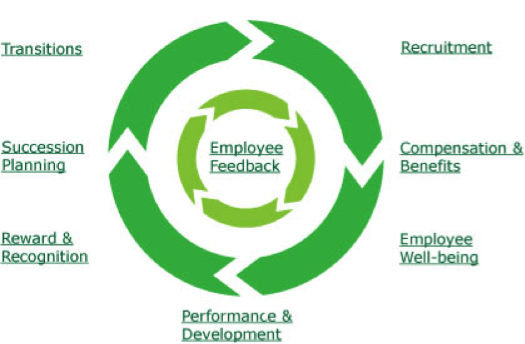
Thinking about your role and your opportunities to impact the engagement of employees within the your organisation:
- Rate the current employee experience against each stage of the life cycle
- Does the current situation support or sabotage engagement?
- Is there a gap between words and actions?
- Discuss what the best experience would look like
- Talk about the role you play and your opportunity to influence at each stage
- Capture any actions
| Systems or symbols | Current experience: does it support or sabotage engagement? | Desired future experience | Actions or opportunities? |
| E.G
Performance management system |
|||
| Office environment | |||
| Employee communication | |||
| On-boarding process |
For more tips and tools to help with your employee engagement, have a look at our People Managers Toolkit, click here. To find out how People Lab can help your organization, request a call-back from our expert Emma Bridger.