We’re living in an age of hyper-personalisation. Where the companies we interact with sometimes know us better than we know ourselves. My kindle has just suggested some new books for me to read, Amazon knows what I want to buy and Netflix has got my viewing habits down to a tee. You might find this really helpful, interesting or intrusive, or down-right rude – hello Facebook ads for saga insurance, I’m not that old!
And yet within the workplace, we’re a million miles away from this. A one-size-fits-all approach still reigns, and is a sure-fire way to disengage. It’s disappointing that there is such a gap between our experiences as customers, and our experiences as employees. At some point, in the hopefully not too distant future, I’d like to see the technologies and approaches we’re using to deliver a brilliant customer experience, make their way into our workplaces, after-all the evidence is clear, that if we get it right with our people, then they’ll get it right with our customers.
But in the meantime, we can use personas to make steps towards a more personal approach in the workplace. Personas are fictional characters, which we create using research, to represent different user types – in this case your employees. Personas can help you to understand the needs, experiences, behaviours and goals of your people. Creating and using personas helps you to see things from the perspective of your people, ensuring that experience design is employee-centred.
To create meaningful employee experiences, we must first truly understand our people, and developing personas is a great way to begin this journey, by understanding who your people are.
But it’s what you then do with your personas that really makes the difference to your employee experience. We know that 90% of the employee experience is based in emotions, and empathy is the superpower that allows you to apply and use personas to create brilliant experiences. We use a simple ‘empathy map’ to do this. An empathy map takes you through a series of questions, to understand what each of your personas are thinking and feeling, saying and doing, seeing and hearing as well as what their pains and gains are.
Here’s an example of an empathy mapping activity we ran at an event – you might recognise the persona!
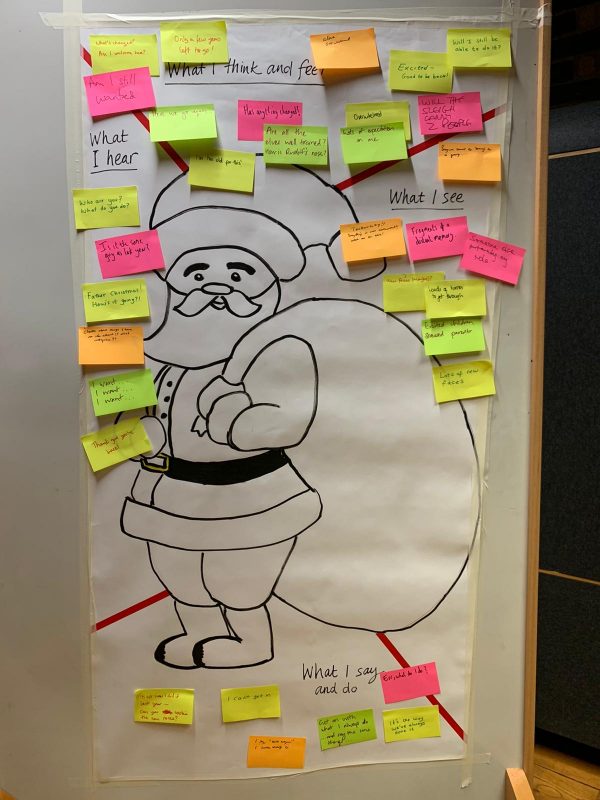
This was obviously a bit of fun to help delegates understand how empathy maps work!
If you’d like to find out more about how to develop your personas and use empathy maps to create a brilliant EX, then join us at our upcoming webinar ‘The Power of Personas’.
In this one-hour webinar you will learn how employee personas could be the key to unlocking better experiences for your people.
We’ll look at:
– What personas are and why they matter
– How personas energise the design process
– Where to get started
– Persona power plays and pitfalls
– How to avoid the persona graveyard
– How to get moving if your persona process has stalled
And we are also delighted to welcome special guest Kara Walsh, senior internal communications leader from US tech company Asurion. Kara will be sharing her experience of the persona development process, what they’ve learned from their product design team and how personas are supercharging their human-centred approach to internal communications. We really hope you can join us.