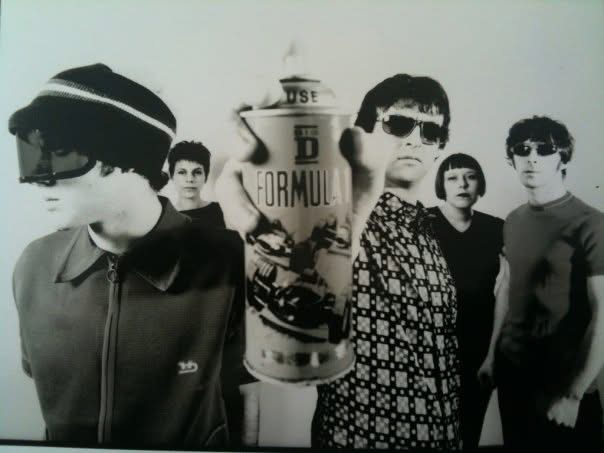
In the 1990s, I played bass in an indie band (called formula one) with family and friends.
We weren’t pursuing some carefully constructed career plan. We were making music, playing gigs and having fun. And then, rather unexpectedly, everything changed.
A friend of ours, Martin Carr from The Boo Radleys, came to see us play and offered to pay for us to go into a studio and record a demo. So, of course, we say yes please!!
When we sent it out, people took notice. Having “produced by Martin Carr” attached to it opened a lot of doors!!
Suddenly, there was serious interest. Record deal offers. Reviews in the NME and Melody Maker. Singles, an album and gigs that got bigger and bigger. We played Reading Festival twice. We had managers, an agent, a publishing deal, PR people, merchandise people and a whole bloody team around us.
It all happened very quickly. We hadn’t expected it, and we certainly hadn’t mapped out how we were going to get there.
What a ride it was.
I loved making music. I loved playing live. I loved many of the strange, surreal experiences that came with it. And I’m still incredibly proud of what we achieved.
But after a few years, I made the choice to move on… it wasn’t a big drama thing.. I just moved to Brighton (from Present where we were all based) which was the beginning of the end.
Why?
Because I figured something out:
You can love something without it being your calling.
From the outside, moving on made very little sense. We had achieved something that thousands of bands dream about. We had momentum, credibility and opportunities. Surely the only sensible thing was to keep going?
But I knew I didn’t want to do it for the rest of my life. I wanted to explore other things, use the degree and masters I had studied so hard for. Loving music and doing music as a job are two very different things and I finally realised that…
That didn’t make the experience a failure. It didn’t mean I wasn’t grateful enough, committed enough or ambitious enough. It simply meant that success had helped me discover what I didn’t want, as well as what I did.
I think we often assume that once we are successful at something, we are obliged to keep doing it.
We’ve put in the work. Other people recognise our talent. Opportunities are opening up. We may even have built an identity around it. Walking away can therefore feel wasteful, ungrateful or even slightly ridiculous.
But being good at something doesn’t automatically mean it is right for you.
Sometimes success is the destination. Sometimes it is simply a very interesting place you pass through on the way to somewhere else.
The experience also taught me lessons that I’ve carried into a completely different career. One of them was not to be too intimidated by status.
When you’re young and find yourself meeting some of your musical heroes, or hanging out backstage with bands like Oasis, Blur and Pulp, you quickly realise that the people you’ve placed on pedestals are, well just people.
A short time later, when I started working with senior leaders and executive teams, that perspective proved surprisingly useful.
Job titles can create an aura around people. So can fame. But neither automatically makes someone wiser, more confident or more certain than everyone else in the room.
Behind the title is still a human being.
That doesn’t mean I never walk into meetings with no nerves or doubts. But I’m not overawed by hierarchy. I’m comfortable challenging senior people, asking difficult questions and saying what I genuinely think.
It turns out that playing bass in a 90s indie band was fairly good preparation for working with the C-suite.
I also learned that careers don’t have to make perfect sense as you live them.
On paper, being in a band, studying psychology, working in employee experience, starting a business and writing books may look like a collection of disconnected chapters. To me, though, there is a thread running through all of them: curiosity about people, creativity, connection and the desire to make something meaningful with others.
Perhaps that is what a calling really is.
Not necessarily one job, one industry or one fixed destination, but a set of things that matter to you and keep resurfacing in different forms.
I have no regrets about leaving the band. I’m so proud that we did something remarkable together (and if I have had a couple of wines always very happy to bore people with the stories and even play a few of our tunes). I’m grateful for the music, the gigs, the festivals, the friendships and the stories. And I still love music as much as I ever did.
But the greatest lesson it gave me was permission to recognise that an experience can be wonderful, successful and worth celebrating, without needing to last forever.
Sometimes knowing when something isn’t your calling is just as important as discovering what is.