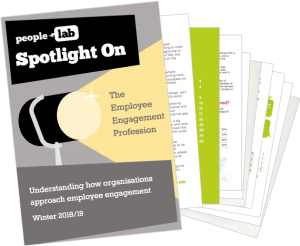
 We launched our ‘Spotlight On’ research back in 2016, to help us understand what we call the ‘employee engagement gap’ – that is, despite an increased focus on employee engagement, and more resources dedicated to it, we’re not seeing the improvements we’d expect. Our research aimed to find out why the gap occurs and more importantly what we can do to close it.
Now in its third year, we’ve had more organisations than ever contribute to our research and the results are in – you can download a full copy of the report here.
For the first time since beginning the research, we have seen improvements across nearly all areas of employee engagement practice, albeit some are very modest! What’s interesting, is that if we look at the bigger picture, for the first time since beginning our research, we’re also seeing small improvements in global employee engagement.
In 2018, AON reported global engagement at 65%, compared to 63% the previous year. We have seen similar improvements reported from the likes of Gallup, Temkin Group, and the CIPD.
It seems that the employee engagement gap is starting to close – perhaps not to the magnitude or speed at which we would like, but there are improvements all the same. We believe that the improvements in engagement practice that we have observed here, are translating into the increases we are seeing in global employee engagement levels.
First a quick look at what we found:
Manager understanding and buy-in
Managers and stakeholders now have a better understanding of engagement, and are more likely to support the need to focus on it.
Structure and role
We saw the numbers of those with formal responsibility for engagement increase, as well as increases in budgets.
Strategic approach
More companies now have both a definition for engagement as well as an engagement strategy. In addition, those measuring impact has also increased. Perhaps unsurprisingly those companies with a strategy in place also have high engagement level as measured by an engagement survey.
Budget vs. priorities
However, we observed some mis-alignment between budget allocation and top 3 priorities – for example change and training for managers are all ranked as top priorities but are low down in the budget allocation list.
Building capabilities
We also saw a decline in budget allocation budget for training and development, for both practitioners as well as managers.
Moving to transformational engagement
And finally, our research is showing early signs of a move from a transactional approach to a more transformational approach to engagement, we are seeing a move to more regular pulse checks and an increased focus on employee voice.
6 steps to engagement success
These findings provide some clear recommendations to help practitioners develop and improve engagement:
- Define engagement and put a strategy in place
This is the starting point for anyone who is serious about developing and improving employee engagement. Use this as an opportunity to figure out what engagement means to your organisation and how you will choose to talk about it. Then you can develop your strategy. A well designed strategy and plan are absolutely critical to ensure the work you do makes a difference to the organisation. It will enable you to focus, prioritise and gain buy-in from stakeholders.
- Develop experts
Building capability is still an issue and needs to be prioritised. How can we expect to see any real improvements in engagement if we are not investing in the skills and capabilities of practitioners and managers? We need people who understand what it is, why it’s important and most importantly, how to develop and improve engagement.
- Demonstrate ROI to be able to invest for success
We’ve seen a small increase in budgets for engagement this year, which is positive. However, if we want to see the trend for budget increases continue, then we have to get serious about measuring our impact and demonstrating that the work we do generates a ROI.
- Align priorities and budgets
It’s important to make sure that budgets are being used to address priorities. This process begins with your strategy, which is why it is so critical to success. A well crafted strategy, with buy-in from stakeholders, will enable budget to be spent in the areas we have identified as a priority.
- Keep moving towards transformational engagement
A quick recap for you:
Transactional engagementis defined by a reactive set of transactions, aimed at improving engagement, often in response to survey results. This approach often begins with a survey, followed by an action plan, actions are then ticked off the list and once complete, ‘engagement’ is done until the next survey.
Transformational engagementhowever, is integrated into the business strategy and culture. It is proactive, and employee insight, ideas, and opinion are regularly sought, harnessed, and acted upon. A natural desire to improve engagement exists within the business.
With this in mind, consider how you can move away from the transactional approach, to a more transformational approach. Taking on board the recommendations outlined here is a great start.
- The potential of tech
There’s no doubt that these solutions have great potential to improve both communication and engagement and are therefore worthy of further exploration. Use your strategy to understand if tech could help you achieve your goals.
Over the coming weeks and months, we’ll explore these recommendations in more detail, giving away free resources to help you. If you haven’t already subscribed to our mailing list, you can do so here, so you can be amongst the first to get the latest news and free tools.
Download the 2018 Spotlight on report here
Watch the webinar where we share the results with the Employee Engagement Alliance below.