In our Spotlight on the Employee Engagement Profession report, we surveyed 76 UK-based companies spanning a range of sectors and industries. We found that 42% of organisations had an existing employee engagement strategy in place, while 45% didn’t have a strategy at all. 13% were unsure as to whether they had one or not.
20% of the organisations we spoke to listed developing an employee engagement strategy as their first priority for the year ahead. However, just 14% of the organisations we spoke to had a company-wide definition of employee engagement.
Defining employee engagement
At People Lab, we define employee engagement as:
The extent to which people feel personally implicated in the success of an organisation.
Employee engagement can be seen as a combination of commitment to an organisation and its values, alongside a willingness to help out colleagues (organisational citizenship). We believe it goes beyond job satisfaction and is not simply motivation – engagement is something the employee has to offer, which cannot be demanded by an employer or contract. Engaged employees want to give their all and do their best, because they feel they have a real, tangible impact on the overall success of the organisation.
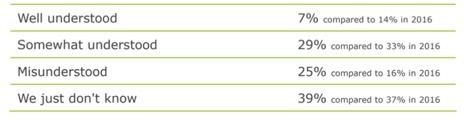
However, we know that employee engagement is defined in many different ways; the 2009 Engage for Success report to government found over 50 definitions of engagement. So, it’s probably not too surprising that many organisations struggle to settle on one concise definition – and even if they do, it’s not always clear to everyone in the organisation. During our research, we found that the companies that did have an existing definition didn’t feel it was well understood:
Why should organisations bother?
As our study shows, many organisations are talking about (and focusing on) engagement – though few have an existing definition to reflect on. Working on developing engagement without first figuring out exactly what it means will likely prove to be unsuccessful, time-consuming, and confusing for everyone involved. After all, how can employee engagement develop and improve if everyone’s on different pages?
Seizing the opportunity
While the results from our research might seem like bad news, we believe this presents a great opportunity for leaders to reach out to their people. A lack of definition – or an unclear one, at least – creates an opportunity to get people together to define what engagement means to them. Having a clear, concise definition will help organisations to develop an employee engagement strategy that’s considerably more likely to succeed, because they’ll know exactly what they’re setting out to achieve. Companies that seize this opportunity will know what they’re looking to measure their engagement efforts against, understanding that everyone in the organisation is working towards the same goal.
Our Director, Emma Bridger, has written extensively on this subject in her book, Employee Engagement. You can download a free chapter here to get started on developing a definition of engagement that works for your organisation. And the second edition will be out soon – we promise to keep you posted!
How is employee engagement defined in your organisation? Do you feel it’s well understood? We’d love to hear your thoughts – let us know via Twitter, or in the comments section below.
Further reading
Spotlight on the Employee Engagement Profession (full report)
Understanding the Employee Engagement Gap (webinar recording)