One of the things I’ve noticed over the past few years working in employee experience is just how many people find their way into EX almost by accident. More often than not, we arrive there through HR, internal communications, learning, culture work or transformation programmes. Very few of us start our careers thinking, “I’m going to design employee experiences.”
Yet here we are.
And increasingly, organisations are recognising that experience design needs to involve a much broader group of people – leaders, operational teams, communications specialists and employees themselves. That means those of us working in EX, IC, HR and related roles are often expected to facilitate and lead that process.
Experiences are no longer designed in an ivory tower, based on assumptions about what employees need. And that’s a positive shift.
But it also means something else: designing experiences well requires capability.
Not just tools or frameworks, but human skills like empathy, creativity, curiosity and problem-solving. The ability to listen deeply, explore ideas and test new approaches rather than jumping straight to a solution.
These aren’t always skills that people teams have had the opportunity to practise before. So when organisations start trying to work in this more human-centred way, the question that often comes up is: where do we actually start?
Learning by doing
One of the most effective ways we’ve found to build capability is through our EX design sprints.
A sprint gives teams a structured way to work through a real employee experience challenge while learning the mindset and methods of human-centred design at the same time.
Instead of talking about theory, the team works through the process together. They explore the challenge, understand the people involved, generate ideas, sketch concepts and test possible solutions.
We always work on a live challenge from the organisation itself. That means the outcome isn’t just learning – it’s progress. And by the end of the sprint, the team has not only practised new ways of thinking. They’ve also moved closer to a human-centred solution for a real opportunity.
But getting there isn’t always comfortable….
Stepping outside the comfort zone
One of the things a design sprint quickly reveals is that building capability isn’t just about learning a new process, it’s about shifting mindset. And that often means stepping outside our comfort zone.
For many of us working in EX, HR or communications, we’re used to being the people who help solve problems. We’re brought in because we’re expected to have the answers.
But human-centred design starts from a slightly different place.
It starts with curiosity.
It asks us to make peace with the fact that we’re not always the experts in what people actually need or want from their experience at work. What feels like a great solution to us might resonate with some colleagues, but not necessarily with the majority.
That’s why the first step isn’t about designing the answer. It’s about understanding the experience. Listening, observing and asking great questions before we begin shaping solutions.
The temptation to jump straight to solutions
Another very natural instinct is to move quickly into solution mode.
Once a challenge becomes clearer, most of us immediately start thinking about how we might fix it. After all, problem-solving is a big part of what people teams do.
But that instinct can sometimes lead us to latch onto the first promising idea and run with it.
And occasionally that works. But just as often it means we’ve invested time, energy (and sometimes significant budget!), into something that doesn’t quite land, or worse, unintentionally makes the experience more complicated for employees.
Design sprints help teams slow that moment down.
Instead of committing to one idea too early, we encourage teams to generate lots of possibilities first. Not because every idea will be good – but because exploring a wide range of ideas increases the chances of finding the ones that genuinely improve the experience.
A moment I see in almost every sprint
I remember working with one team recently during a design sprint where we’d just moved into the ideation phase.
Up until that point the energy had been great. We’d mapped the experience, explored the insights and identified the moment that really needed attention.
Then we asked everyone to start generating ideas – lots of them.
You could almost feel the shift in the room.
And when we explained that they absolutely weren’t meant to be finished or perfect ideas – that the goal was simply to get as many possibilities out as we could, you could see a mix of relief and uncertainty.
People started sketching ideas that felt rough. Some were ambitious. Some were completely impractical. But almost all of them sparked new thinking in the group.
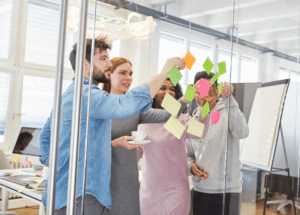
And within about twenty minutes, the tables were covered with possibilities that none of us would have arrived at if we’d just focused on one “best idea” from the start.
It’s moments like these where you can see capability building really beginning. When teams experience what it feels like to think differently.
Why we use design sprints
This is exactly why we use design sprints when working with teams.
A sprint creates the space for people to practise human-centred design in a structured way, working through a real employee experience challenge while building capability at the same time.
Teams explore the problem, generate ideas, test concepts and learn what works.
And because we always work on a live organisational challenge, teams don’t just leave with new skills.
They leave with momentum.
Curious about how a design sprint works?
If you’re curious about how design sprints work in practice, and how they can help your team build capability while solving a real experience challenge, then we’re running a webinar next month where we’ll walk through the approach in more detail.
👉 Find out more or register for the webinar: What is an EX Design Sprint?
It would be great to see you there.
@Katie