One of the most common questions I get asked when working with companies to engage their people is “what can we practically do to improve engagement?”. Knowing where to start can be a challenge so I thought it would be useful to share a practical tool I have used over the last 20 years in my work which has the potential to make a significant difference to the engagement of your people.
In my experience the tools that are most useful in improving engagement take a strength-based approach. I’ve shared many blogs over the years that make the case for using positive psychology in our work to understand why it is that engaged people outperform others. As a reminder engagement is a lead indicator of business success rather than a lag indicator: engagement comes first.
Drawing on the science of happiness we need to create opportunities for our people to have experiences at work which facilitate positive emotions. When we have these experiences we release higher levels of dopamine, which in turn switch on learning centers helping us to work harder, better and smarter.
So why is it then that conversations about engagement often begin with an analysis of everything that is wrong with our workplaces? Strategies designed to engage employees more often than not begin by evaluating problems, looking at what erodes engagement, and then asking how can we fix these problem areas? This approach is referred to as a deficit approach to employee engagement, and is compounded by over-reliance on the results from the annual staff survey as the starting point for action. It’s very rare that companies look at the positive findings from the survey and ask how they can learn from this insight.
This is the approach I used in my early days of working within the field of employee engagement: going around the survey cycle and focusing on trying to fix all those areas that scored poorly. However, after a few years of trying to fix the broken areas, I found that this approach wasn’t really working. Sure there would be some improvements in certain areas, but overall, whilst a huge amount of effort and resources were going into tacking the problems, the solutions just weren’t sustainable. By chance I read an article about a technique called Appreciative Inquiry, which changed the way I approached employee engagement and has informed my work ever since.
What is Appreciative Inquiry (AI)?
Don’t let the name put you off! The concept of AI was originally developed by Dr David Cooperrider, Dr Suresh Srivasta and Dr Frank Barrett, at Case Western Reserve University. Essentially AI is a simple, strength-based philosophy and approach, which argues that there is just as much to be learned by understanding what works, and what could work, in various situations, instead of always focusing on all that is wrong and how issues and problems can be fixed. When I first came across AI, I immediately recognised the potential of this tool for developing engagement. I recalled various meetings and workshops on engagement I had attended over the years, where the conversation had started by looking at everything that was wrong and how we could fix it: this approach felt counterintuitive to developing engagement. The approach itself was not in anyway engaging and was often quite depressing! People left these sessions feeling fairly helpless about the current situation, overwhelmed by how much was wrong and needed fixing in order to improve and develop engagement amongst their teams and the organisation in general.
It only takes a few cycles of this approach for the organisation to develop learned helplessness when it comes to engagement. If you begin to hear phrases like “nothing will ever change”, and “here we go again”, coupled with a drop year on year in survey response rates, you know you’re in this place within your own organisation. On discovering AI, I wondered what might happen if we started a conversation by understanding what actually works, and what engagement looks and feels like for our people.
How Does AI Work?
AI provides a simple framework to follow to enable groups, teams and the organisation to have different conversations about engagement. The methodology is based around what is known as the 5-D cycle.
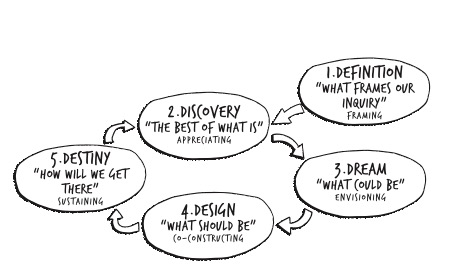
The 5-D cycle offers a simple process to follow when planning any AI intervention. The inquiry takes place by following the cycle through its entirety in the following way:
- Definition
This stage sets up the topic for the AI intervention, essentially framing the inquiry. There are a number of ways in which this can be done. Firstly if there is a problem or issue that the company wishes to tackle with respect to engagement, this would then be re-framed. So for example, if you have an issue with stress or absence you’d like to delve deeper into using AI, you might choose to define your topic as promoting wellbeing or creating a great place to work.
- Discovery
Once the topic for the inquiry has been established the process begins with the discovery phase. This part of the process is all about reflecting on “best of” or “positive experiences”, by collecting stories from participants. So for example within the context of engagement participants might be asked to share stories about times within their work life when they were really engaged, in order to understand what was happening and what were the conditions that made this experience possible.
- Dream
Once participants have spent time thinking about current or previous experiences within the theme of the AI intervention, they then move onto the dream phase. This section focuses on what could be, and asks that participants envision a future which is different from today. This phase is all about the art of possibility, really emphasising participants to focus on what COULD be, challenging them to stretch their thinking and allow themselves to get excited about a different future. Questions or activities are designed to inspire participants to create a clear and tangible view of where they want to be, asking them to describe this future in detail.
The dream phase builds on the learning and discussion from the discovery phase, encouraging participants to create something new.
- Design
Next comes the design phase which moves thinking on from what COULD be, to what SHOULD be. This stage of the process enables the participants to build on their learning and conversations from the previous stages to begin planning and prioritizing what would work well. Questions are asked around what needs to change in order to bring to life their thoughts, ideas and vision from the previous stages. Changes are identified and the seeds of plans and projects are put into place.
- Destiny
The final stage of the AI cycle is destiny. This stage really focuses on what needs to happen in order to deliver or act upon the design discussed in the previous stage. This stage looks at how participants can be accountable for activities and plans they are going to personally take forwards, be responsible for, or even experiment with. This stage really emphasizes the potential and value of small changes participants can make today in order to move the organisation closer to where they want to be.
AI is a powerful tool to use within engagement: whether using it as a framework for engagement per se, or using it to look at aspects of engagement such as promoting wellbeing at work, or authentically recognizing employees. Its power is in the fact that it encourages participants to talk about, and share, real life experiences and stories: looking at what has already worked in the past or is working today. These real life stories and experiences are a great foundation to then imagine future possibilities, which then don’t seem so far-fetched or over-whelming.
From a psychological perspective, given AI is strength based, the process itself generates positive emotions and experiences: it is an engaging process in itself. The process also sets out a clear purpose at the outset and facilitates autonomy amongst participants: they contribute their own stories and ideas and develop their own solutions.
Finally, having a group work together to imagine future possibilities is an excellent way of both involving employees, and giving them a voice: both enablers of engagement. It also aids sense checking that people are on the same page and there is motivation to move in the same direction.
At People Lab we have taken the AI framework and developed an “Engagement Toolkit” which is a simple, user-friendly range of tools to help you navigate the process. We have used this toolkit with 1000s of companies over the years achieving significant results, not just improvements in engagement but positive impacts on business outcomes such as increasing retention and reducing absenteeism. If you would like to find out more about our award-winning toolkit we’d love to hear from you.