It’s official: Richard Branson hates ties.
Although it doesn’t exactly make for breaking news, it’s quite amusing to see Branson ambushing innocent smartly dressed office-types and snipping their ties off with scissors. When I first heard about his escapades, I wasn’t sure what to make of it; what’s so wrong with a tie?
It’s a strip of material that covers buttons, a formal addition to a suit or uniform, a usual businessman’s accessory. And what comes next? Deborah Meaden declares war on pencil skirts! Mark Zuckerberg bans cufflinks! Bill Gates fires all employees in possession of a briefcase! Branson claims that ‘everyone in business looks the same and dresses the same’, and that ties ‘only exist because bosses, after being forced to wear ties all their life, are determined to inflict the same fate on the next generation.’
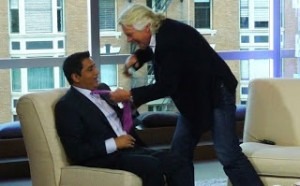 Virgin employees are expected not to wear a tie, and Branson claims to often carry ‘a pair of scissors in my top pocket to go cutting people’s ties off!’ Despite the odd image of Branson hacking ties to pieces (see photo above – nightmarish), I have to say that I agree with him in many ways.
There’s an odd expectation that working in a professional role means having to dress in the same way as everyone around you, as if what you’re wearing somehow indicates how good you are at what you do. If you wander into the office in trainers or your favourite baggy jumper, you’re at risk of not being taken seriously. If you dress casually, surely you must have a casual attitude towards your work? Slack dress code = slacker in the office?This concept is completely outdated, but continues without fail. If you stand outside any London tube station at 6pm, dozens of suits and stilettos and briefcases and bluetooth headsets are churned out into the open, like a bizarre vending machine. Branson’s right – everyone does look the same.
It’s an odd concept, isn’t it?
A nation of business professionals, all desperately trying to set themselves apart from each other with our unique skills and qualifications – and how exactly do we present this, visually? By wearing the same as the next guy, and joining the identikit masses – burying our individual skills beneath several layers of navy polyester, click clacking our individuality to death with those painful patent heels.
When I first joined the team at The Communications Lab, I accompanied our Director to an event. I remember it vividly – I was wearing a bright teal dress, printed with flowers and birds, and the obligatory black blazer to make it less club, more conference. Emma was wearing a smart wrap dress, teamed with electric blue tights and an animal print scarf. We went to join the other hundred or so people in the dining room for lunch, and as I waited in the queue, I scanned the room. My first thought? Everyone is wearing black. Everyone is wearing a suit. Everyone looks the same.
I’ve spoken to a few people about this. One of my very good friends claims that he needs to wear a suit and tie to do his job, and never works from home. He says that working in a professional environment, and wearing clothing that he associates with work, helps him to separate the personal from the professional. However, another friend of mine works from home regularly and wears her PJs all day, Monday to Friday. My point is, different things work for different people. If (like my friend) you need to wear a tie and dress in a suit to do your job well, then do it. I think Branson’s only mistake is in thinking that everyone will gladly give up formal business attire – some people like dressing like that! Leave ’em alone!
However, if wearing a suit and tie makes you feel uncomfortable and stifles your creativity, don’t do it. Why should we have to dress in a certain way just to make the right impression? If we’re good at our jobs, it’ll be there on paper – not on the labels of our expensive suits and shoes.
What’s your view – what do you think your work clothes say about you? Are you suited and booted or casual in the office? Leave your comments in the section below.