Spoiler alert – my answer is no and here’s why. Employee engagement is a difficult term to pin down. When I first wrote ‘Employee Engagement’ back in 2013, there were over 50 definitions and counting. Being able to improve engagement and measure it has to start by being clear on your definition, but it’s hard to know where to begin.
One of the most worthwhile contributions to the debate on what employee engagement is comes from a recent discussion report from Jonny Gifford and Jake Young of the CIPD (Gifford, J. and Young, J. 2021, Employee engagement: definitions, measures and outcomes. Discussion report. London: Chartered Institute of Personnel and Development).
In the report they draw on a rapid evidence assessment of employee engagement, to explore definitions, measures and outcomes. The report is well worth a closer look and can be found here.
The aim of their report was to provide practitioners with a “stronger understanding of employee engagement and a clearer basis to act on it, building the credibility and impact of those specialising in this field”. In their report, they begin by asking if there is agreement as to what employee engagement is. And it will come as no surprise that their answer is no. However, despite the lack of agreement amongst not just practitioners, but academics too, they don’t believe that we need to abandon the label of employee engagement. They recognise that the field, and practice, of employee engagement has made a positive contribution to progressive people management practice. However their call to action is that we can, and should, do better when it comes to defining what we mean by employee engagement.
I have always argued that the starting point for any practice looking to develop and improve employee engagement, must begin with a shared understanding of what we mean by this. Gifford and Young also argue this point stating:
“any respected profession must take its core terms seriously. To use them to good effect, they need to carry weight. For that we need shared understanding of what they are; and for that we need some precision. There is a time and place for crystallising what core terms mean and how they should be used. Nailing this frees us up to discuss what matters most.”
In the report, they recognise that employee engagement can be difficult to define, and is often seen as “contentious and woolly”. They offer a helpful understanding as to why this is the case, explaining that it is often treated inconsistently. On the one hand employee engagement is described as a “broad umbrella term for an overarching area of people management”, but at the same time, it is also treated as a “precise construct that can be defined and measured”.
It is useful to consider these two perspectives when seeking to understand what employee engagement could mean to your own organisation. Gifford and Young argue that problems arise when we try to mix these two perspectives. For example we might talk about employee engagement in a holistic way, viewing it as more of a philosophy, but then share annual survey results where we claim that two out of three employees are engaged, which is very precise. To accurately measure employee engagement, we must begin with clarity on our definition, otherwise how do we know what we are measuring?
This theme is something I talk about through my book ‘Employee Engagement’*, and in it I share solutions to help you get clear on not only your definition and approach to employee engagement, but your measurement approach as well.
Within their report Gifford and Young make the distinction between employee engagement and work engagement:
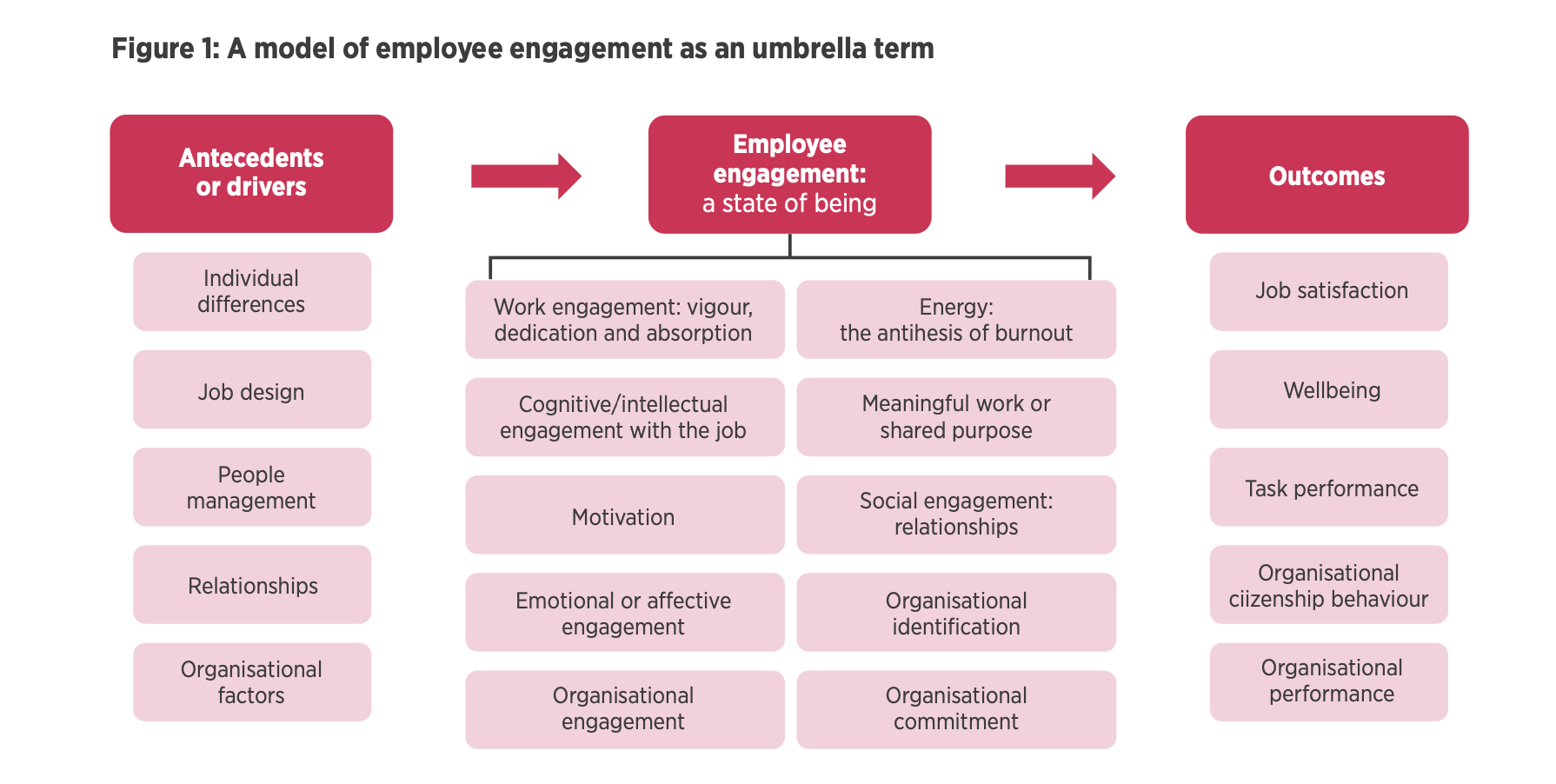
- employee engagement – describes a broad subject area or umbrella term that includes work engagement and other more specific terms, such as intellectual engagement, organisational engagement, motivation and organisational commitment
- work engagement – to describe the specific state of vigour, dedication and absorption that features most strongly in the scientific
They have developed the following model to help navigate the use of employee engagement as an umbrella term. The model firstly views employee engagement as a psychological state of being, and the terms associated with engagement are detailed. The model also outlines the antecedents or drivers of engagement, as well as the outcomes of engagement.
A model of employee engagement as an umbrella in the report is shown here:
I think this is a really useful contribution to the field of employee engagement and a great starting point to understand how you will define it in your organisation.
As ever I’d love to hear what you think?
Followers of Emma Bridger and People Lab can receive 20% off the cost of Emma’s book ‘Employee Engagement: A Practical Introduction‘ by purchasing directly through Kogan Page and using the code AHREE20