Internal Communication is changing – fast
Employees today expect consumer-grade experiences, personalised communication, and authentic connection. At the same time, artificial intelligence is transforming how we work, learn, and lead. For internal communicators, this marks a pivotal shift. The skills that defined success a decade ago aren’t necessarily the ones that will sustain it in the years ahead.
At People Lab, we’re seeing more and more IC professionals pause to recalibrate — to reflect on how their roles, priorities, and mindsets need to evolve. And that’s exactly the theme explored in a recent webinar run by our sister company, The EX Space: Recalibrate and Rise: Building Future-Ready IC Skills in the Age of AI.
From competencies to capabilities
For years, IC frameworks have centred on competencies — what communicators need to do. But the context has changed. Traditional models were built for a world of predictable channels and linear communication flows.
Today, AI can automate tasks like content generation, scheduling, and analytics. But what it can’t do is empathise, influence, or inspire — and that’s where communicators must focus their energy.
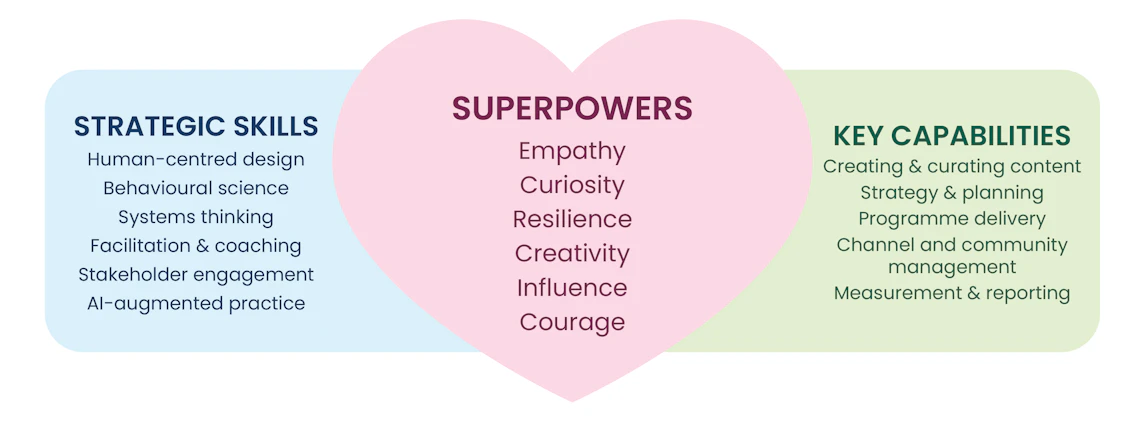
The People-First IC Capability Model, reimagines what it means to be an effective communicator in this new era. Instead of a static checklist of skills, it describes a dynamic set of capabilities built across three layers:
- Human strengths – the deeply human qualities that define our IC “superpowers.”
- Strategic skills – the higher-level capabilities that elevate our impact.
- Foundational capabilities – the essentials that still matter, but matter differently.
The human strengths that set us apart
Empathy. Curiosity. Resilience. Creativity. Influence. Courage.
These are the traits that AI can’t replicate — the very things that help communicators build trust, drive engagement, and navigate complexity. They’re not soft skills; they’re super skills.
They’re what enable IC professionals to act as the emotional engine of the organisation — connecting people to purpose, aligning teams, and fostering belonging in an era of constant change.
The strategic skills that redefine value
Building on those human strengths means also developing strategic skills that help IC evolve from tactical delivery to organisational influence. That includes:
- Human-centred design – treating communication as an experience, not a broadcast.
- Behavioural science – understanding what drives action.
- Systems thinking – seeing how messages interact with culture and structure.
- Facilitation and coaching – enabling dialogue and collaboration.
- AI-augmented practice – using intelligent tools to enhance, not replace, human insight.
These capabilities turn IC from a service function into a catalyst for change.
The foundational capabilities: reimagined, not replaced
Core disciplines like content creation, channel management, and measurement still matter — but they’re no longer the differentiator. AI can handle the mechanics. What makes a communicator indispensable is the ability to translate data into meaning and strategy into action.
Thinking like an experience designer
The most future-ready communicators are those who think like experience designers — deeply understanding the employee journey, designing from the user’s perspective, and crafting experiences that shift how people feel, not just what they know.
It’s this mindset shift — from message maker to experience shaper — that defines the new era of internal communication.
What Comes Next
AI isn’t the end of internal communication. It’s the reboot we’ve been waiting for.
This is our opportunity to lead the transformation — to elevate the craft, build new capabilities, and design experiences that truly connect people and purpose.
If you’re ready to explore what this means for your team, start by exploring The People-First IC Capability Model, developed by our sister company, The EX Space. It’s a free diagnostic designed to help communicators assess their strengths, identify growth areas, and reimagine their future impact.
And if you missed the original webinar, you can still watch the recording here — a great way to dive deeper into how the IC profession is evolving in the age of AI.
Because the future of communication isn’t about keeping up. It’s about rising up — with empathy, courage, and creativity leading the way.